LIVING ECOLOGIES FOR HUMAN RESTORATION
A live research initiative exploring regenerative African urbanism through nervous-system landscapes, ecological infrastructure, and future settlement models.
Not a
development.
A research
platform.
NERA DISTRICTS is a live research initiative by Studio RDN-X exploring regenerative African urbanism through nervous-system landscapes, ecological infrastructure, climate-responsive housing, sensory environments, wellness-integrated urban systems, and future settlement models.
Situated on a 200-acre barrier island in Badagry, Nigeria — where the Atlantic meets Badagry Creek — NERA is designed around a single conviction: that the built environment is not neutral. That where you live shapes how your body feels, how your nervous system regulates, how your children come to understand the world.
AUREON — Studio RDN-X's environmental intelligence system — is the embedded intelligence layer throughout NERA: monitoring, sensing, and adapting the ecological and spatial conditions of the settlement in real time.
"NERA is the place. AUREON is the intelligence. Together they form a living research prototype for future African settlement."
Land, Water,
Corridor,
Intelligence.
The settlement is organized around five ecological corridors running perpendicular to the Atlantic coast — drawing ocean breeze deep into the interior, connecting tidal edge to creek edge, and anchoring the AUREON sensor network that monitors microclimate conditions throughout.
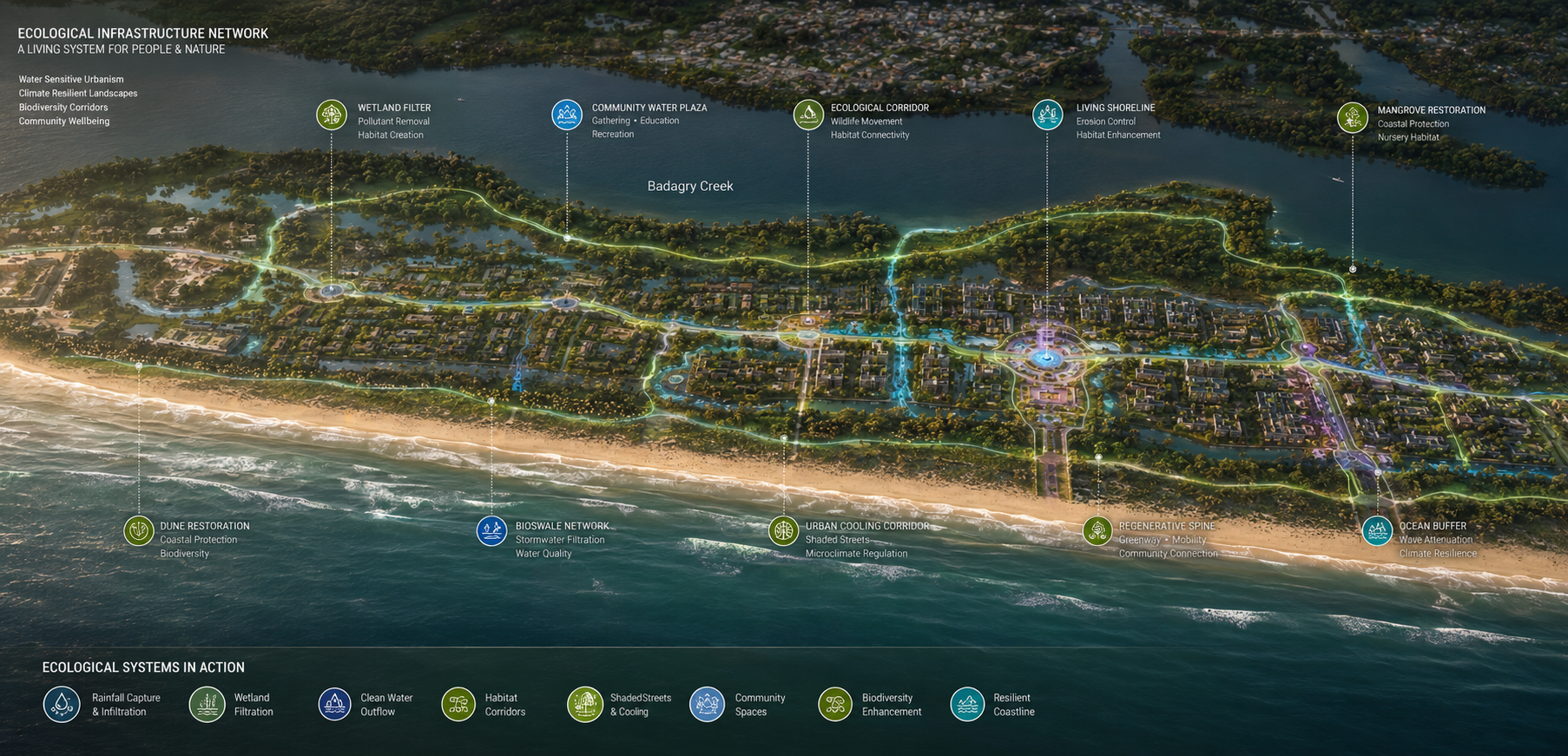
ECOLOGICAL INFRASTRUCTURE NETWORK — A LIVING SYSTEM FOR PEOPLE & NATURE · BADAGRY BARRIER ISLAND
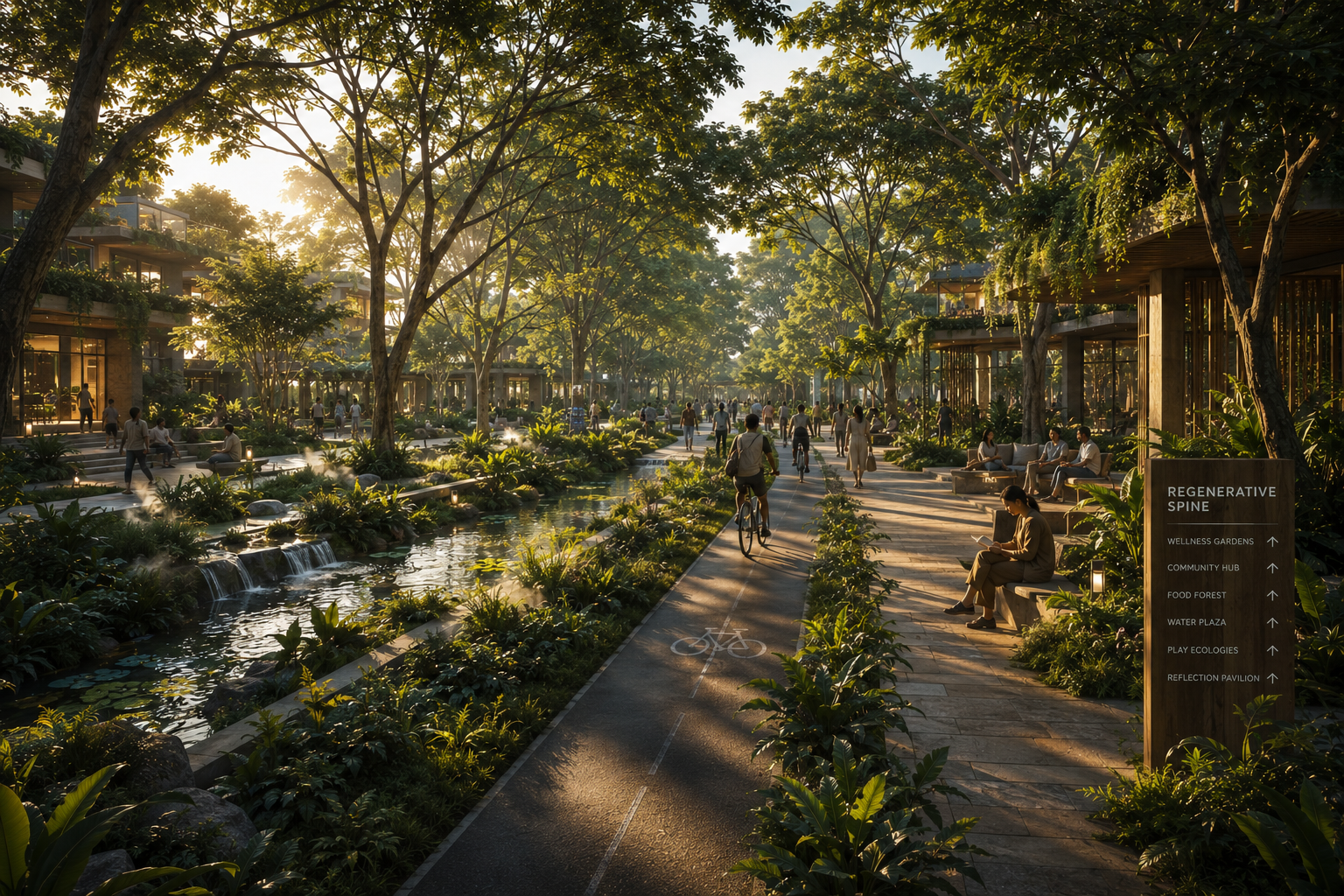
THE REGENERATIVE SPINE — WELLNESS GARDENS · COMMUNITY HUB · FOOD FOREST · WATER PLAZA · PLAY ECOLOGIES
NERA DISTRICTS — SETTLEMENT ECOLOGY SCHEMA · ECOLOGICAL CORRIDORS, TYPOLOGY ZONES, WELLNESS SPINE, AUREON INTELLIGENCE NETWORK
Architecture
has a
physiology.
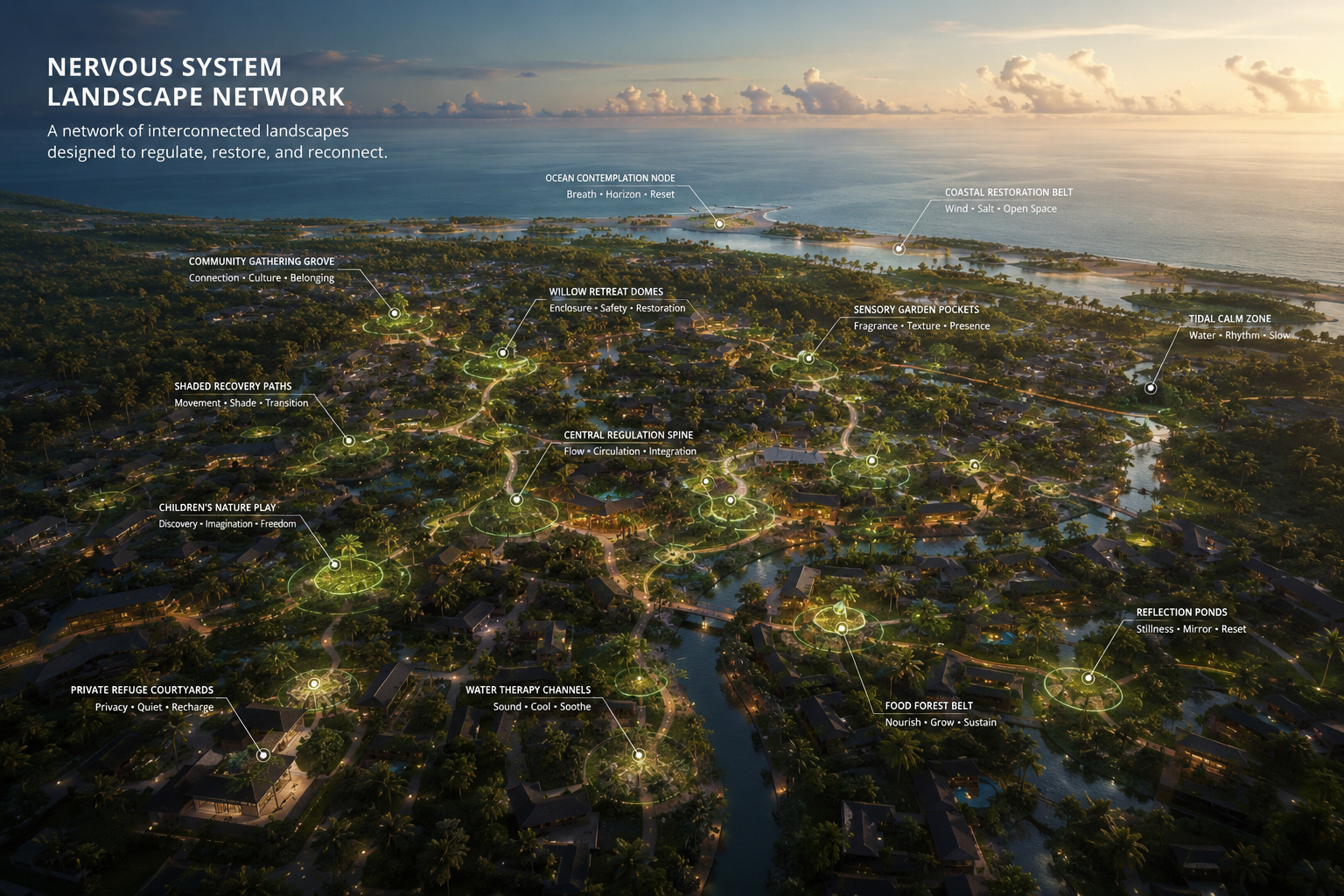
Space produces hormones. Silence is a material. The distance between a window and the nearest tree canopy is a neurological variable. We are building for bodies — for the nervous systems of people who will sleep here, raise children here, work here, age here.
Every spatial decision carries a biological consequence. We are trying to make those consequences benevolent.
Structured around three sensory registers: auditory (moving water, wind through bamboo, absent traffic), visual (fractal plant geometry, filtered light), and proprioceptive (textured ground, grade changes, barefoot pathways). Dwell time is designed to be long. Shade is total.
The settlement's primary pedestrian network is a shade system that happens to permit movement. Canopy is continuous. Ground cover is tactile. The path meanders in response to tree placement. AUREON monitors the thermal and acoustic profile of every pathway in real time.
Distributed across the landscape — woven from planted willow, bamboo, or indigenous flexible-stem species. Semi-enclosed spaces: acoustically dampened, thermally cooled by evapotranspiration, visually contained. The effect: being held by landscape rather than built form.
Every water feature is a working system — stormwater attenuation, greywater treatment, wildlife corridor — that also serves a neurological function. The sound frequencies of moving water, the reflective quality of still surfaces: managed with the same precision as structural engineering.
Fruit trees, kitchen gardens, herb plantings distributed throughout the settlement — simultaneously food security, ecological education, and multi-sensory environment. The smell of flowering herbs, the rhythm of productive planting: deliberate triggers of neurological states associated with safety and abundance.
Atmospheric zones of ecological density embedded at key points in the residential fabric — where the landscape becomes dense enough to feel immersive, the light becomes filtered, and the body registers the shift from urban stimulation to ecological calm.
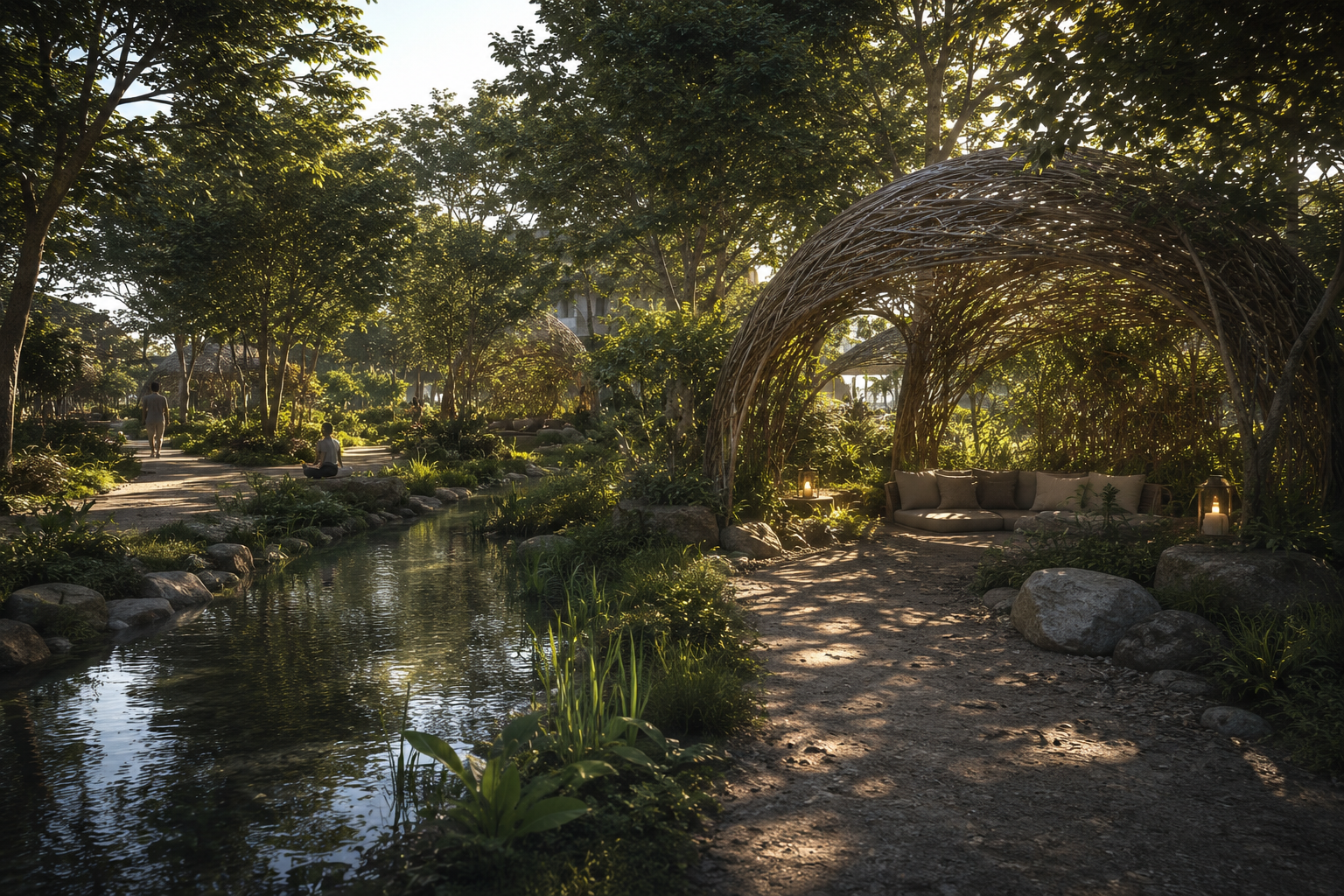
NS REGULATION GARDEN — WILLOW DOME RETREAT · THERAPEUTIC WATER CHANNEL · SHADED DECOMPRESSION PATHWAY
NEUROECOLOGICAL SENSORY FRAMEWORK — NINE DIMENSIONS OF NERVOUS-SYSTEM REGULATION
The oldest
curriculum
is ecology.
Children do not need more equipment. They need more ecology. Exposure to complex, unmanaged natural environments produces measurable improvements in attention, emotional regulation, risk assessment, creativity, and resilience.
Loose soil, gravel, sand, water, long grass, short turf, shade, sun, exposed root systems, planting dense enough to disappear into. No fixed equipment. The landscape is the toy.
Shallow channels, rain-fed pools, seasonal flooding zones. Children learn water before they learn about water — through the body, not the classroom. Hydrological education at ground level.
Child-scaled growing areas at every residential cluster. Raised beds, low-canopy fruit trees, pollinator gardens. What begins as play becomes, over years, fluency in ecological stewardship.
Logs, stones, bamboo offcuts, clay, seed pods — materials children can arrange, build with, and dismantle. The research basis for divergent thinking, collaborative play, and spatial intelligence.
A winding educational path through the ecological buffer zones. Interpretive elements embedded in the landscape itself — through planting choices, habitat structures, ecological events. Not on signs.
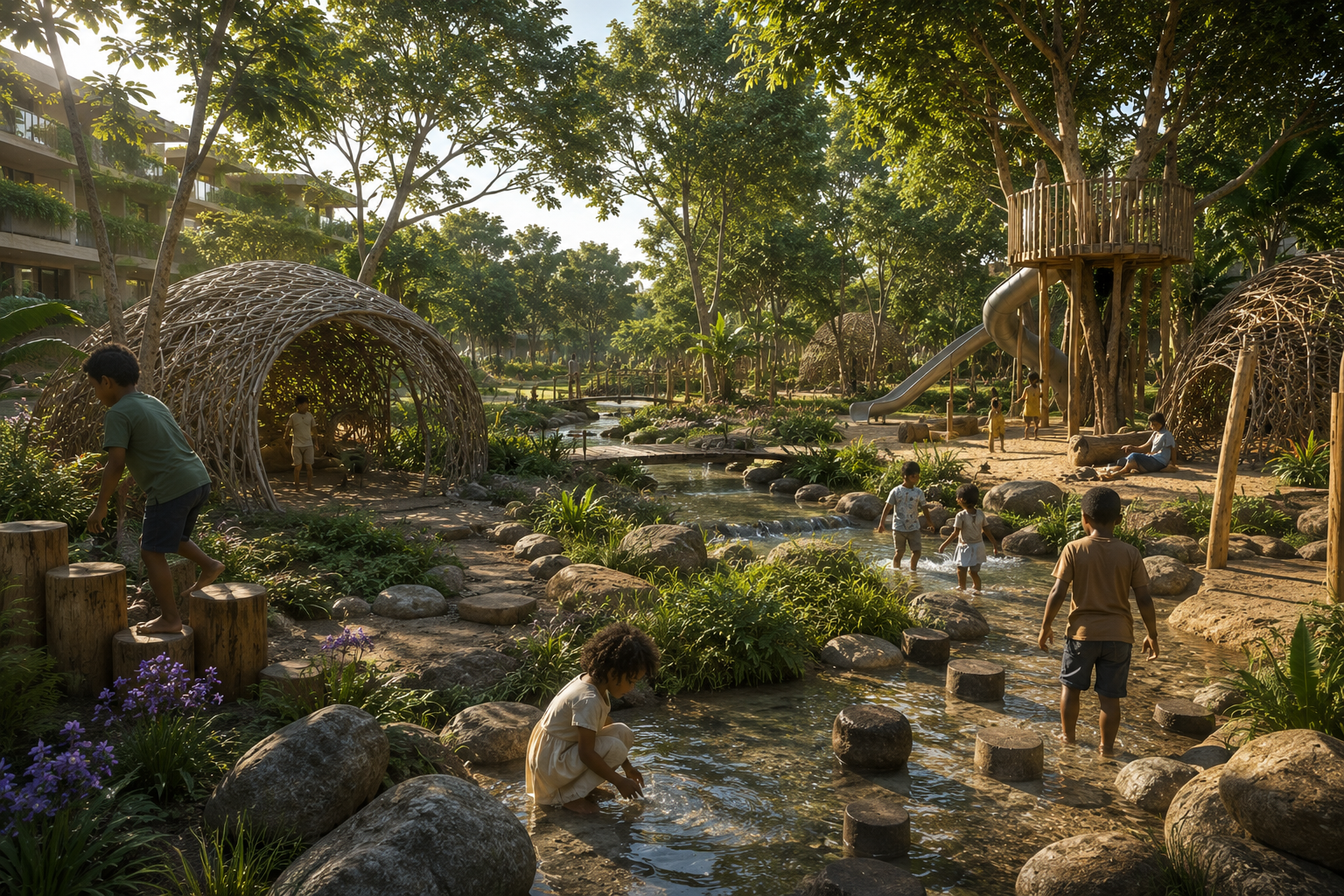
REGENERATIVE PLAY ECOLOGY — WATER PLAY · WOVEN DOME · LOOSE PARTS · TREEHOUSE · SENSORY LANDSCAPE
NERA CHILDREN'S ECOLOGY NETWORK — SIX PLAY AND LEARNING SYSTEMS
Water is
the first
architect.
In a coastal barrier island ecology, water is not an amenity. It is the organizing logic of the settlement — the intelligence that determines land use, drainage, material selection, and landscape programming at every scale.
Dual entry points for water into the NERA hydrological system — tidal inputs managed through coastal buffer infrastructure, rainfall captured across all roof and permeable surface areas.
The barrier island aquifer is a living resource — recharged by rainfall and protected by mangrove edge conditions. AUREON monitors salinity and drawdown to prevent saline intrusion.
Natural filtration through engineered wetland systems — simultaneously flood management, water treatment, wildlife habitat, and sensory landscape. The wetland filter is ecology as infrastructure.
Treated water distributed through the NS regulation gardens, sensory channels, and reflective pool systems throughout the settlement — performing therapeutically while returning to the hydrological cycle.
Closed-loop greywater management from all residential typologies — treated and returned to the landscape irrigation and wetland systems. Waste-to-resource at settlement scale.
Shade-first design, deep verandas, building orientation to prevailing south-west breeze, thermal mass, night-sky radiative cooling, and cross-ventilation corridors — all monitored and tuned by AUREON.
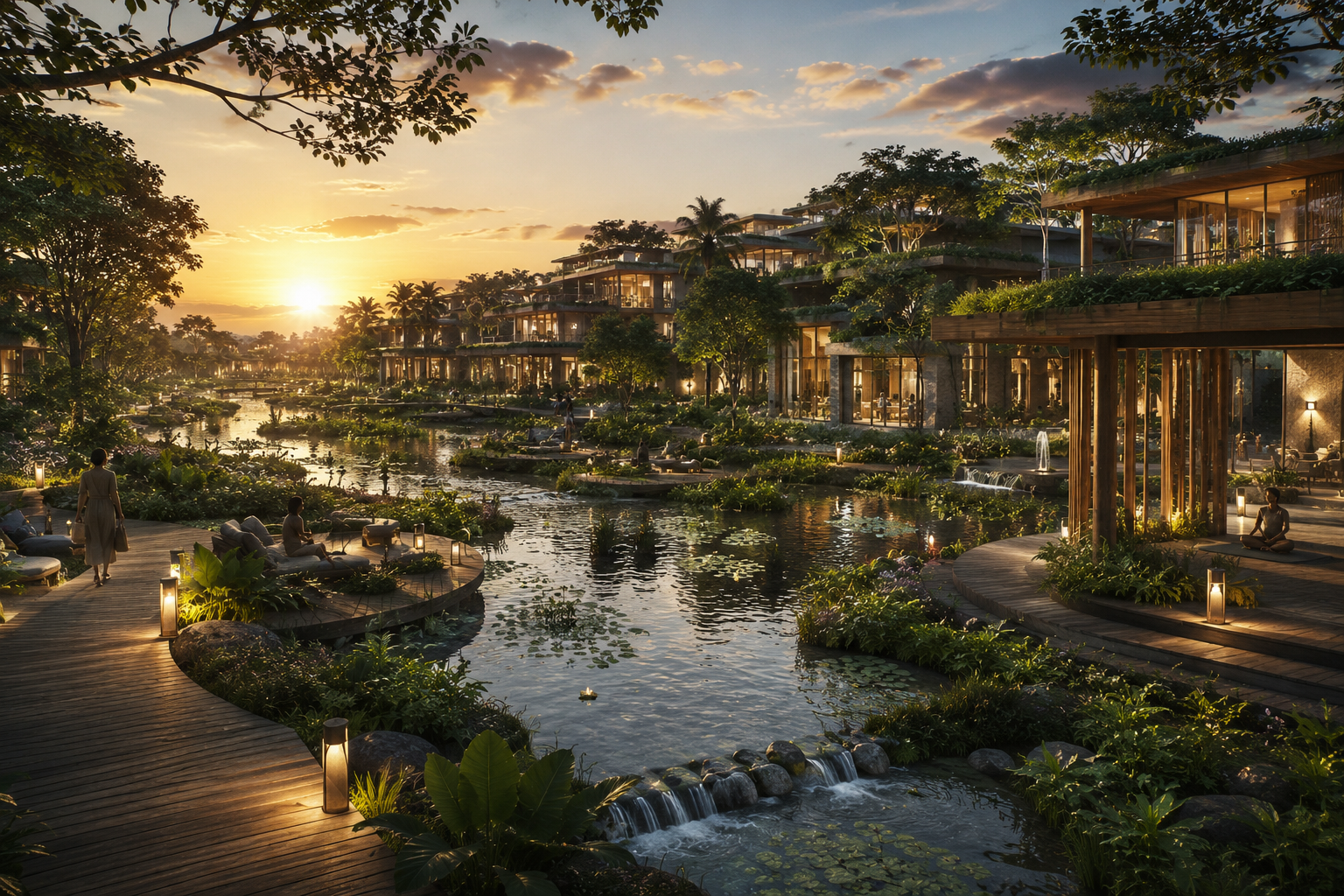
THERAPEUTIC WATER NETWORK — LILY PONDS · CASCADE · REFLECTION · WETLAND EDGE · SUNSET ATMOSPHERE
NERA WATER INTELLIGENCE — COASTAL HYDROLOGICAL CYCLE + TREATMENT NETWORK
Residential
in relation
to ecology.
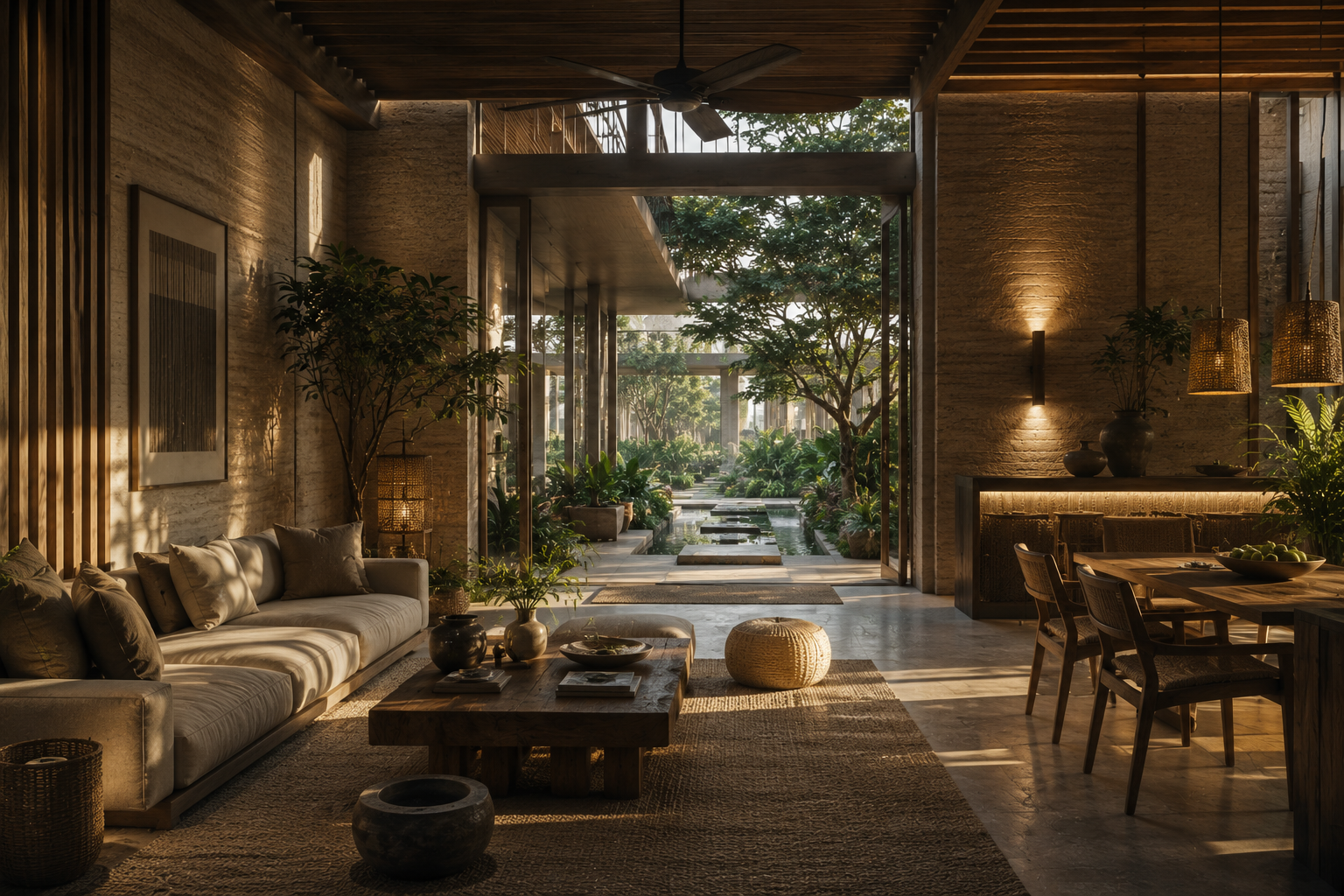
The residential typologies are not isolated product types. They are nodes in a living network — each positioned relative to its ecological surround, its acoustic environment, its solar orientation, and its proximity to therapeutic landscape infrastructure.
Maximum proximity to the Atlantic. Deep verandas oriented to the prevailing south-west breeze. Shade-first passive design. AUREON-tuned natural ventilation and thermal mass. Direct access to coastal sensory landscape and first ecological corridor.
Mid-density precision-grain urbanism. Courtyard-oriented units with layered privacy from street to interior garden. Each unit integrates edible planting, rainwater harvesting, and greywater recovery within its domestic footprint.
Inspired by the West African compound model. Semi-private shared courtyards activate community formation. Designed for multigenerational habitation. Shared threshold spaces calibrated for spontaneous community encounter.
Living with the creek rather than above it. Water-sensitive construction, flood-adaptive ground conditions, tidal ecology interface — mangrove proximity, therapeutic waterways, fishing reaches. AUREON monitors tidal and salinity conditions.
Embedded throughout the settlement rather than sequestered in a campus. Wellness infrastructure is part of daily routes, play landscapes, and the nervous-system garden network — not a destination but a condition.
The horizontal connective tissue of the settlement — commercial, educational, wellness, and cultural programming. Activated by shade, animated by water, designed for genuine community formation rather than mere co-habitation.
The
settlement
senses itself.
AUREON is the environmental intelligence infrastructure embedded throughout NERA DISTRICTS. Distributed sensors, adaptive algorithms, and continuous monitoring create a settlement that learns from its own ecological conditions in real time.
EXPLORE AUREON RESEARCH →AUREON's sensor network spans all five ecological corridors, the wellness spine, the therapeutic water systems, and the residential typology zones — creating a continuous environmental data layer that feeds adaptive responses: adjusting shade structures, activating water features, tuning airflow through corridor management, and flagging ecological performance metrics in real time.
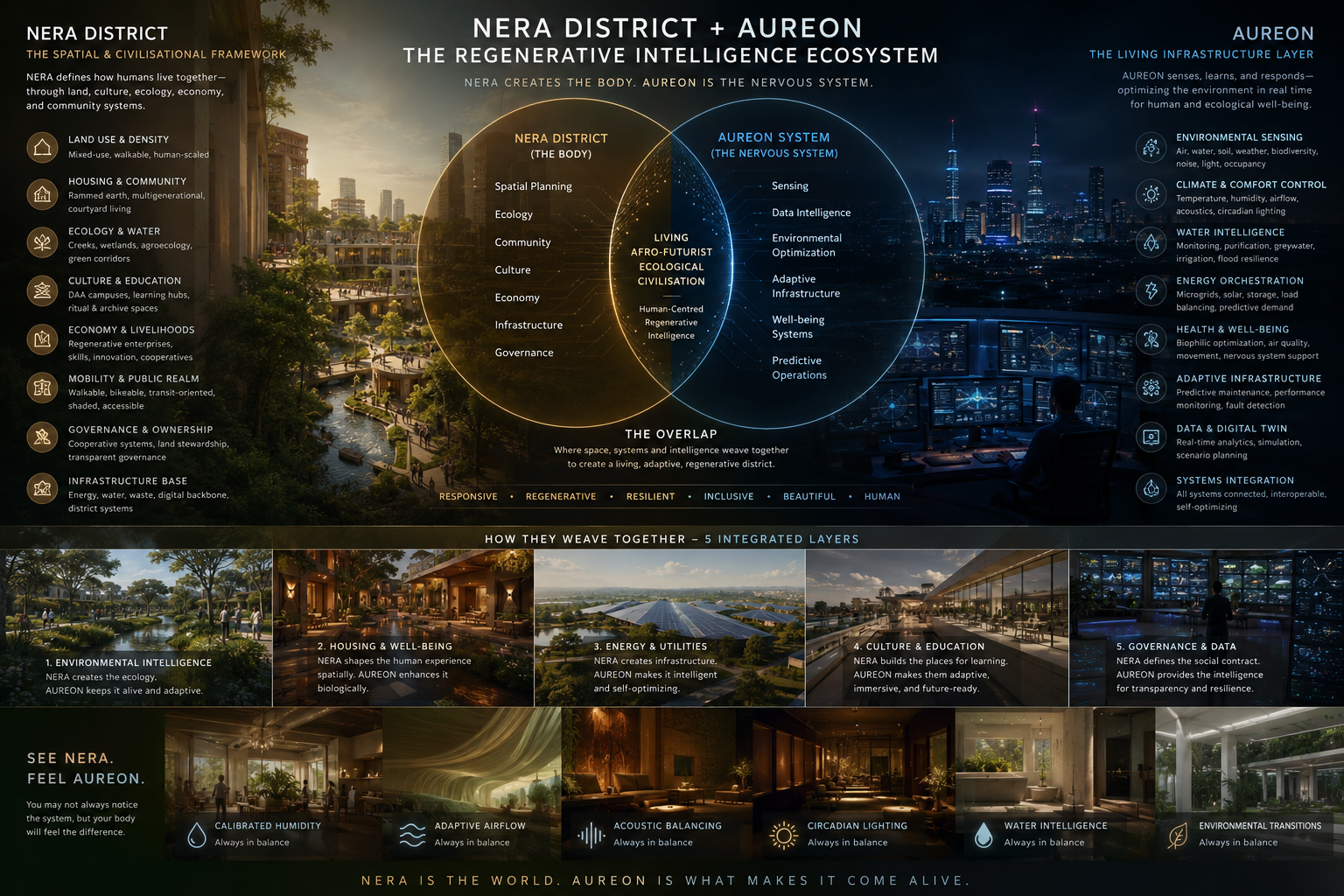
NERA DISTRICTS + AUREON — THE REGENERATIVE INTELLIGENCE ECOSYSTEM · NERA CREATES THE BODY · AUREON IS THE NERVOUS SYSTEM
AUREON INTELLIGENCE LAYER — 8 MONITORING SYSTEMS EMBEDDED THROUGHOUT NERA DISTRICTS
The
question
is here.
Africa does not need better versions of the cities that were built for other climates, other economies, and other bodies. The future of African urbanism is not a faster Lagos or a cleaner Nairobi. It is something that has not been fully built yet — and that is precisely where the opportunity lives.
NERA DISTRICTS is an act of spatial imagination rooted in a specific place. A barrier island in Badagry, shaped by Atlantic wind and lagoon water, carrying the weight of centuries and the possibility of an entirely different kind of century to come. It is one settlement. Two hundred acres. A finite number of buildings, pathways, gardens, and water systems. But a settlement is never only what it contains. It is also what it demonstrates.
That ecological intelligence and architectural ambition can occupy the same drawing. That the nervous system and the ecosystem can be managed by the same design logic. That multigenerational, climate-adaptive, biophilic urbanism is not a European export but an African inheritance, reconstructed from first principles for a climate, a culture, and a future that belong to this continent.
"We are building for 200 years, not 20. The trees we plant will be architecture before the mortgages are paid. That long view — ecological, social, architectural — is the most radical thing about NERA."
Enter
NERA.
We are now in conversation with the first cohort of residents, research partners, and institutional collaborators. If NERA DISTRICTS resonates with your values, your work, or your vision for the future of African urbanism — we want to hear from you.